Thursday, May 5, 2011

Collecting Goals, Again

Warning: I am being more long-winded about this topic than is probably called for, but I can't seem to help myself. I will come around to my main point eventually.

In my previous post, I rambled on about the need for focus in a retro game collection. It may be hard to accept, but you can't collect everything. But so what? You figure out what you most desire, compile a "want list," then go about acquiring the items on it, right? Sure... but what happens when you get everything on your list?

I'm surprised at how often I've seen collectors complete a want list, then lose interest and sell off the collection. Sometimes they drop out of the hobby entirely. Of course, tastes do change. Maybe they used to really enjoy playing that Microvision but then discovered the Game.com and never looked back – I don't know. But if they were just after the thrill of the hunt, and didn't really want the things they were hunting, they probably shouldn't have been collecting them in the first place. On the other hand, there's nothing wrong with enjoying the "search and acquisition" phase of the hobby either. It may happen that you complete a want list, and enjoy having it completed, but still miss the thrill of the hunt.

This has been on my mind a bit lately as I've pretty much completed my original want lists. When I began actively collecting retro games in the mid 1990s, I started with the goal of reacquiring all the pre-NES games I used to have in the early '80s, which my parents gave away shortly after I picked up Nintendo's system in 1988 or so. Beyond that, I wanted to get all the games my childhood friends owned, then any games I may have borrowed from relatives or other acquaintances back then, then that one game I rented from that one place that one time... you get the idea. And of course I quickly discovered other games that made their way to the top of my original want lists. For example, during the '80s, I had not known that there was a sequel to Pitfall!, even though I loved the original game. Obviously Pitfall II became one of my most desired titles once I became aware of its existence.
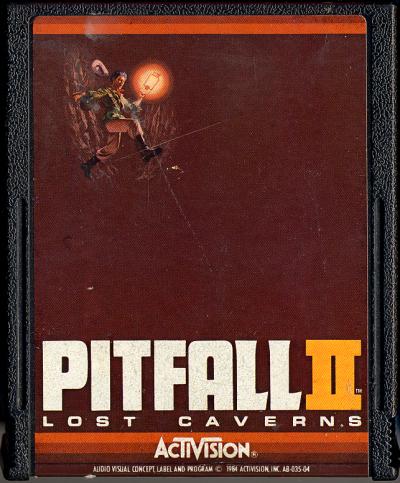

The Lost Caverns were really "lost" to me – I didn't know this game existed until 1994!
Photo: AtariAge


After 17 years though, I find that I already own most of what I originally wanted. Make no mistake: there are plenty of games that aren't in my collection that I wouldn't object to having, but very few are on my "specifically looking for" list. And it's kind of a bummer. Nevertheless, I have no temptation to stop collecting as others in this situation sometimes do. I trimmed some of my excess stuff a while ago – mainly junk NES games I had no interest in – but I really enjoy owning my collection. I'd just like to continue enjoying collecting it.

As I've been trying but failing to state for two posts now, I've finally figured out how I want to have my cake and collect it too. It's not a huge revelation or anything – it's pretty obvious actually – but I'm excited about it anyway because it's re-energized my collecting interest. I'll describe it in my next post.

Tuesday, April 19, 2011

Collecting Goals

Time to state the obvious: In collecting, it helps to have specific goals.

"But I want it all!" you say, trying to stuff yet another RCA Studio II cart into your cramped apartment.  More power to you, I say.  But trying to collect everything is probably destined to result in disappointment, which will manifest itself should you ever get around to actually playing that Studio II cart.  You have to narrow down your focus.

I think most retro game collectors who, like me, gave away their original childhood collection (in my case, not with my full consent) often start with the idea of recreating it.  I know that was one of my earliest collecting goals, but now I've pretty much achieved it – albeit with some caveats that I'll go into in another blog post.

After that, where do you go?  Well, an obvious choice to get the games you always wanted "back in the day" but never managed to obtain. I expect that for many collectors, that won't be too difficult.  The games you probably most wanted back then were the well-advertised, popular ones – in other words, the ones that are now common.  When I was a kid, I didn't have Space Invaders for the Atari 2600.  I played it at my cousin's house a couple of times, and loved it.  With all its variations and options, I daresay it's more fun than the original arcade version!  Back then, I longed for that marching, invading phalanx with every fiber of my 8-year-old being, but I never got it.  Now, I've had so many extra Space Invaders cartridges pass through my collection that I probably could have built a second house with the things.

Once you get what you've always wanted, you can start looking for the fun-but-obscure titles that everybody else wants.  I'm referring here to the great games you never heard of back in the day.  Even if you were incredibly well-informed years ago, I'm betting there's plenty of stuff you missed.  After all, what did you have to go on back then?  Your friends, playground gossip, maybe a subscription to Electronic Games magazine?  Today, the Internet makes it possible to be entire orders of magnitude better-informed than back in those days.  It won't take more than casual searching to discover a whole bunch of great old stuff that is new to you.

But eventually you might exhaust even that avenue.  After 17 years of collecting, I feel I have, or at least am closing in on it.  So to avoid aimless collecting, I need to find a new quest (or series of quests).  I think I have, but I'll go into it in a later post.

Friday, April 15, 2011

Aha, so that's how to win at E.T.!

A little eBay is a dangerous thing.  I've been spending a little time there lately, mostly looking for some Atari 2600-compatible controller extension cables (which are strangely less common than I would have expected).  A few days ago I searched for "Atari" – which results in too many random hits to be useful if you're looking for something specific, but can be fun to try on occasion simply because it results in so many random hits.

I usually don't find anything I want to buy with this search, but this time it turned three things, including this:


I guess now is the time to admit it – I actually don't hate E.T., the whipping boy of the Atari 2600 era.  I enjoy it.  Admittedly it has its flaws, but it's a surprisingly fresh Atari 2600 title once you figure out how to play it and avoid accidentally falling in the pits.  Howard Scott Warshaw deserves more credit, especially since he had to conceive of and program the game in something like four months.

I love classic video game books.  Aside from the games themselves, books are perhaps my favorite things to collect.  They are direct windows to the era, thoughts captured in printed form at the time when these games were contemporary.  Given that, and my fondness for E.T. the video game, I had to Buy This Now for $10.

It is an instant classic.  It's a tiny book, paperback dimensions but only 32 pages long.  Each page is printed on colored, heavy-gauge paper.  And it's so very refreshing to read something written about E.T. before it went on to become one of the most hated games ever.  The opening paragraph describes it as "the first 'emotional' video game," where you identify with the protagonist and his fate rather than merely trying for the high score.  The book argues, not inaccurately, that this is the future of video gaming, and is "stuff of the heart."  How strange to think they are talking about E.T.!

The strategy detailed in the book isn't bad either.  The authors outline ways to play for points, or for speed – what would be called a "time attack" today.  But even with only 32 pages, they manage to repeat themselves a lot.  Yes, there are several power zones, and you should quickly memorize where the Call Ship Zone is... I get it!  There is, however, a very handy map that lets you visualize the game's screen layout as a cube – something that I never thought of before.

This book seems rather rare.  I am currently the only person on LibraryThing to have it in my collection.  So it may be hard to score a copy, but I definitely recommend it for all fans of classic video game books.  It's a wonderful relic.

Incidentally, there are scans of the entire book at AtariMania.  Strangely, the cover design and page layout is totally different than my edition of the book, even though the text seems to be identical.

Friday, April 8, 2011

On Clocks

It may seem strange to start off a new retrogaming blog with a post about clocks, but here goes.  Time waits for no man, or something like that.

I've been thinking about clocks because of something that happened to me about a week ago.  I was in my game room (all retro game collectors need one), playing NES Wizards & Warriors.  I've played through that game dozens of times before – my best friend had it growing up – yet somehow, this time I missed the "Axe of Agor," the game's most powerful projectile weapon.  One of the game's later bosses is a lumbering zombie thing whose menace is somehow undercut by his Barbie-like pink coloring.  This guy goes down easy enough when you have the axe, but without it, you're pretty much toast.

Like I said, I've beaten this game dozens of times before and I wasn't about to let Barbie Zombie humiliate me this time, especially not after I'd already spent about an hour getting to him.  So I kept on battling, over and over.  Eventually I did manage to best him and complete the game.  I felt pretty proud of myself until I realized how late it was.  I ended up getting to bed about an hour later than normal, and was pretty tired at work the next day.

Afterward it occurred to me that I had no way of knowing what time it was because there was nothing in my game room to tell me.  Obviously I need to put a clock in there.  But what kind of clock should it be?  Any old clock can tell you the time, but if a clock's going in my game room it should match the retro gaming theme.

At first I thought I'd just get one of the amateur custom-made video game clocks that are available cheaply on eBay.  A search for "video game clock" turns dozens of these.  That's still an option, but most of them look kind of dinky to me.  I'm not sure I'd be proud to have one of these hanging on my wall, even if there's a picture of Mario on it.

The awesome Pong Clock from Sander Mulder is no longer available, but it would have been too expensive anyway.

More searches turn modern retro-themed clocks like this one shaped like Pac-Man, but it seems awfully big.  Shelf space is usually at a premium in game rooms.  And anyway, it's modern.  A retro-game room seems like it needs a retro clock.  The Virtual Pac-Man Museum lists several vintage Pac-Man timepieces, but these aren't cheap these days.  One of those Paxxon Pac-clocks is currently on eBay for over $100.

I got to thinking: most of my game systems are from the '70s and '80s; maybe my clock should be too.  But that leads to a new conundrum: now I have two decades of clock designs to choose from.  But I think I can limit it.  I want something that's not TOO big – which is sometimes asking a lot from vintage electronics – and something that looks period.  That means woodgrain.

I don't know if a clock can look more '70s than the VTG Kmart Digital AM/FM Radio Flip Clock:


For a more '80s aesthetic, I could go for the Soundesign 3691-C Alarm Clock Radio.  I'm pretty sure I actually owned one these in the '80s.  But ironically it doesn't really look that different than some clock radios made today:


Or, I could get a product clock from the era.  I don't collect Coca-Cola merchandise, but I love drinking the soda, and this Coke clock from the '70s wouldn't look that out-of-place in a retro game room.  Unfortunately it's rather large at 18"x12":


I'm still undecided; I need to think about it more.  I'll post whatever I end up going with.

Wednesday, April 6, 2011

A new blog approaches. (R)ead or (F)lee?

Greetings.

I collect retro or "classic" video games.   These terms have fluid definitions; after all, today's state-of-the-art game is tomorrow's retro treasure (or trash).  But for my purposes, "retro" is anything older than roughly the Sony PlayStation 2.  That includes the Atari 2600, Nintendo NES, Sega Genesis, Mattel Intellivision, and my personal favorite – the oft-maligned Magnavox Odyssey².  Of course, cabinets from the Golden Age of Arcades are part of this landscape; I'm talking your Pac-Mans, your Defenders, your Mouse Traps – those kinds of titles.  I grew up with these games, as did an entire generation.  Many of us simply look back fondly on the games as pleasant memories from our past, but some of us – the collectors – are dedicated to owning the real things.

I've collected other things in my time, I've known collectors from other hobbies, and I work for a company that specializes in collectibles (not video games, though).  I've found out that no matter what your specialty, the collecting hobby is a fun one.  You learn a lot, make a lot of interesting discoveries, and get to experience the pleasure/pain of owning a whole bunch of awesome stuff/junk.  The video game collecting hobby has an added benefit in that you can have fun playing the great games in your collection... or laughing at the terrible ones.  Us longtime collectors know: this is a fantastic hobby!

This blog is a place for me to share my wisdom (if you can call it that), observations and random thoughts about classic video game collecting.  It will give me a place to post photos, keep track of things in my collection, and provide me an excuse to think about old video games even more than I already do.  Naturally many of my posts will be focused on experiences building my personal collection, but I hope to cover topics that will be of general interest to other collectors as well.

Keep on keeping those classics!